
Adjustable Probe Base U307458 - FAQ
Frequently Asked Questions
Q: Why invest in adjustable probe bases when our existing setup has worked for many years?
A:
Because it improves small ring measurement accuracy.
Traditional fixed probe setups work very well when:
- You master and measure the same size
- You rely on comparative measurement
- Small alignment errors cancel out
Modern applications increasingly require:
- Absolute measurements
- Mastering at one size (e.g., 1") and measuring at another (e.g., 0.040")
- Sub-2 µin accuracy across a wide range
At very small diameters, probe alignment sensitivity increases dramatically. What is negligible for rings 1” and larger becomes the dominant source of error at small diameters. The adjustable probe base removes that sensitivity rather than forcing you to live with it.

Q: If our current probes are aligned carefully, why isn’t that sufficient?
A:
Because at small IDs, perfect-looking alignment is not good enough.
For example:
- A lateral misalignment of just 0.0005"
- Can produce approximately 25 µin of measurement error in a 0.040" ring
That error:
- Is invisible during assembly
- Can change when probes are removed and reinstalled
- Can drift over time due to internal stress relief
The adjustable probe base allows alignment to be performed under actual measurement conditions, not inferred from mechanical setup.

Q: What does “peak-seeking alignment” actually give us?
A:
It allows the measurement itself to become the alignment reference.
Instead of assuming the probes are aligned, you:
- Place the probes in the smallest ID to be measured
- Adjust lateral position while observing the readout
- Stop at the maximum reading, which corresponds to true axial alignment
This:
- Eliminates hidden cosine and geometry errors
- Makes alignment observable and repeatable
- Locks in accuracy for all subsequent measurements
Q: Isn’t this just adding complexity for the operator?
A:
Actually, it reduces complexity in daily use.
While initial alignment takes a few extra minutes:
- Reinstallation errors are eliminated
- Repeat adjustments are minimized
- Measurement confidence increases
Operators spend less time questioning results, rechecking parts, or chasing unexplained shifts.

Q: Why wasn’t this needed before?
A:
Because older probe designs were developed based on comparator-style measurement.
In those systems:
- You master on the same size you measure
- Alignment errors cancel automatically
Once you require:
- Absolute size
- Wide measuring range
- Sub-micron accuracy at very small IDs
The old assumptions no longer apply.

Q: Does this improve real-world results, or just theoretical accuracy?
A:
It improves real-world results.
Customers report:
- Reduced variation after probe changes
- Improved correlation between machines
- Greater long-term stability
- Fewer unexplained measurement shifts
In practice, it means less scrap, fewer disputes, and higher confidence in small-ID measurements.
Q: Does this capability give us a meaningful advantage over companies that don’t have it?
A:
Yes, this capability gives a distinct accuracy advantage over present methods. To our knowledge, no other instruments currently offer this capability.
Our air-bearing system allows:
- True peak-seeking alignment
- Stable, absolute probe motion
Achieving repeatable, near-perfect probe alignment is a common industry challenge. The ability to detect a peak reading to millionths may not be supported on other systems. The adjustable probe base is not just an accessory, it is a way to fully utilize the instrument you already own.
Q: What’s the bottom-line value?
A:
You are not paying for adjustability. You are investing in the elimination of a dominant error source.
The adjustable probe base:
- Removes a known limitation at small IDs
- Preserves accuracy across the full measuring range
- Future-proofs the system as tolerances continue to tighten
It’s an investment in measurement confidence, not just hardware.
Q: How does the adjustable probe base work?
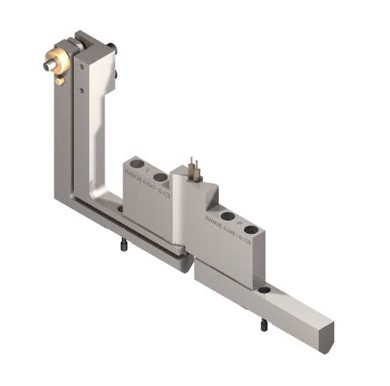
A: The left probe contact can be adjusted laterally (in the y-direction, where x is the measurement axis and z is the vertical direction). The right probe is fixed and cannot be adjusted. If the two small ring probes are laterally misaligned relative to each other, the system will measure ring diameters smaller than their actual size. By adjusting the left probe to obtain the maximum diameter reading, the probes can be properly aligned. This alignment procedure only needs to be performed once after the probes are installed in the instrument.
Q: How much of an improvement can I expect?
A:
That depends on the measurement tolerances and the size of rings that you calibrate.
The charts below show the error for different ID probes at different levels of misalignment without adjustable bases. A misalignment of 0.0005" represents best-case assembly conditions, while 0.0015" represents a realistic worst case.


Although the charts show large absolute errors, keep in mind that the measurement error is the difference in error between the master error and artifact error so when the master and artifact are the same size, the errors cancel.
With adjustable probe bases, if the probes are aligned within 2 µin of the relative max as seen on the readout, then the cosine error will be less than 2 µin.
Q: Is there a simple formula to predict cosine error for ring measurement based on probe lateral misalignment?
A: Yes.
Cosine Error = probe_lateral_misalignment^2/(2*(ring_diameter – probe_diameter))
The formula is a first-order approximation good to within 2.5% for all cases in the charts above.
Q: Adjustable probe bases address probe lateral misalignment. How do we address probe height misalignment?
A:
For small rings, probe height misalignment is best handled by aligning the table top surface to be level with the measurement axis (see user manual). Cosine error due to ring gage bore perpendicularity is typically negligible. Tilting for a minimum reading won’t improve the reading and may introduce error due to probe height misalignment.
Q: Can we measure probe misalignment?
A:
Yes. Search your user manual for “misalignment”. If you do not see the information then request “How to calculate probe misalignment” document from P&W.
Q: Does single probe measurement eliminate probe misalignment error?
A:
Effectively yes but there are trade-offs:
- Single probe measurement requires that the ring be firmly secured to the table. Any movement of the ring with respect to the table will result in a measurement error. P&W offers U600130 – LMU Single Probe Ring Clamp for clamping small rings.
- Split probe measurement of rings is typically faster than single probe measurement.
Adjustable Probe Bases with optional 0.040-0.125” (1.00-3.18 mm) Internal Dual Probes installed.
 Free USB
 Product &
 Celebrating